
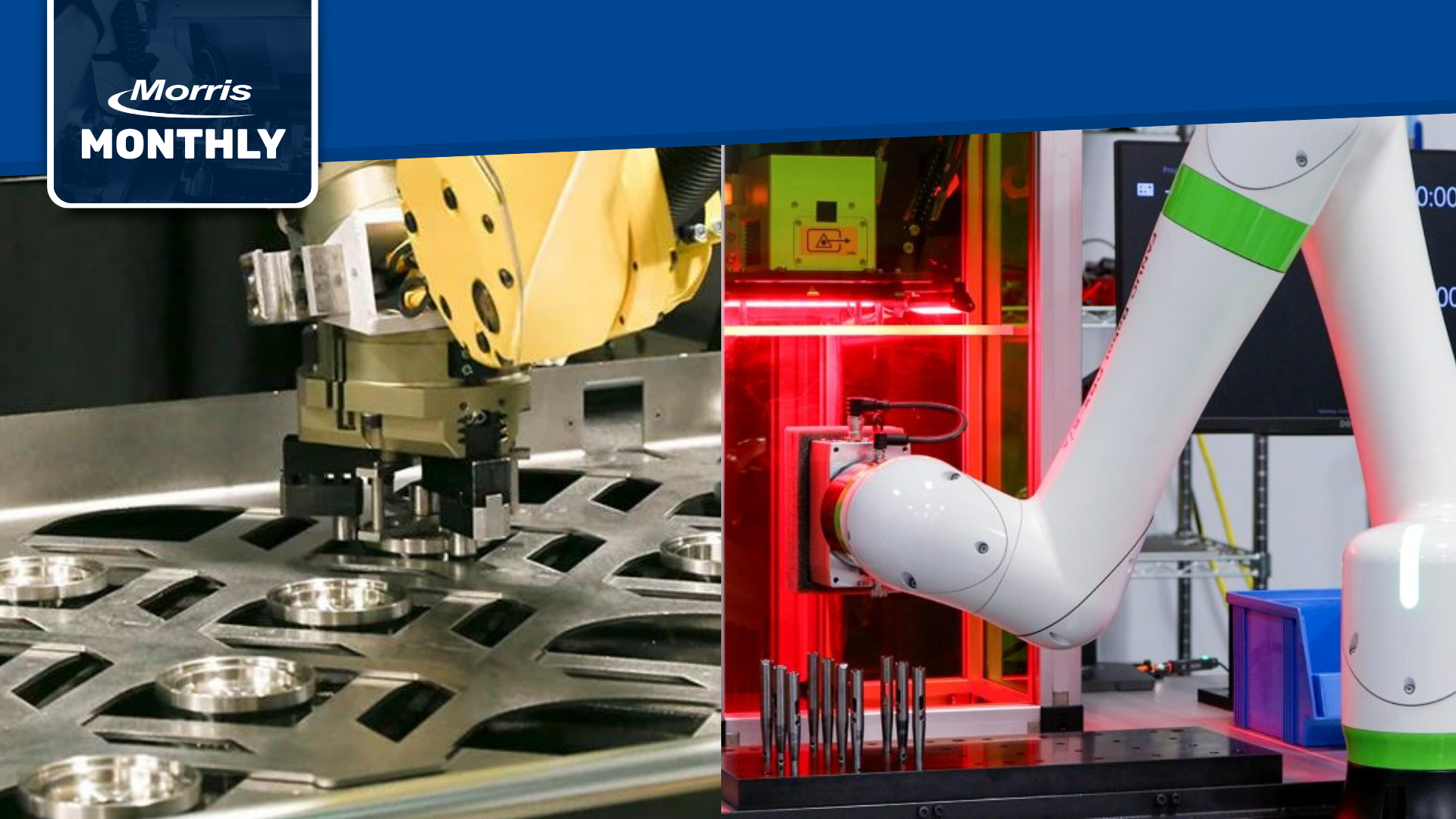
Most manufacturers are not looking to automate everything at once. They are looking to start where it makes the most operational sense—repeatable and reliable jobs that directly impact throughput, increase availability of skilled labor, and deliver measurable ROI.
Start with High-Volume, Repetitive Loading and Unloading
The strongest first candidates for automation are not the most complex parts. It may not even be the highest-volume jobs that are the first candidates for automation. They are the jobs that are seen on a reliable schedule and come back every week, month, or quarter. They are the jobs that contain repeatable part quality, where part tolerances are not chased which would stop the automation and require frequent manual intervention. These jobs typically still consume significant manual labor and add little production value. Repetitive loading and unloading cycles create the fastest return because they eliminate non-productive operator time, increase spindle utilization, and allow machines to run longer without constant supervision.
When you evaluate a part for automation, start with the basics: how many parts per job, what is the part cycle time, are finished and raw parts exchanged immediately after every cycle or does the machine frequently sit idle, and what is the operator doing during machine cycle time? If an operator is standing idle while the machine cuts, that is under-utilized capacity. If setup time is minimal and part dimensions are consistent, automation can take over that task and free the operator for higher-value work like quality checks, tooling changes, or running additional machines.
Machine tending automation works best when parts are repeatable, cycle times are predictable, and annual volume is high enough to justify the investment. A part that runs 10,000 times per year with a two-minute manual load cycle represents more than 330 hours of operator time. That kind of volume creates clear ROI. Parts with frequent design changes, unstable fixturing, or inconsistent material supply should wait until the process stabilizes.
Repeatability matters more than complexity. Simple parts of stable dimensional quality and that are scheduled frequently almost always outperform complex, low-volume parts as first automation projects. The goal is not to automate the hardest operation on the floor. The goal is to automate the operation that will deliver measurable throughput gains, reduce labor dependency, and prove the value of automation across the organization.
Automate Part Inspection and Quality Verification
Quality verification is another high-value application for early automation. In-process probing, post-machining inspection, and automated measurement reduce manual touch time, catch dimensional issues before bad parts leave the machine, and protect throughput by eliminating scrap and rework downstream.
Manual inspection adds cycle time, introduces variability, and pulls operators away from other tasks. Automating inspection does not just save labor. It improves consistency, provides real-time feedback to the machine control, and supports unattended runtime by confirming that parts meet specification without human intervention. When a probe detects an out-of-tolerance condition, the machine can adjust tool offsets or stop the process before producing more scrap.
The best candidates for automated inspection are parts with tight tolerances, high scrap costs, or regulatory compliance requirements. Aerospace components, medical device parts, and high-performance automotive applications often require dimensional verification on every piece. Automating that verification protects quality, reduces inspection labor, and creates traceability without slowing production.
Automated inspection also supports lights-out manufacturing. If the machine can verify part quality on its own, it does not need an operator present to confirm dimensions between cycles. That capability extends available runtime, improves machine utilization, and allows manufacturers to run second and third shifts with minimal staffing.
Target Operations with Skilled Labor Constraints
The labor gap in manufacturing is not going away. Shops continue to struggle with operator availability, training time, and the cost of staffing multiple shifts. Automation addresses that challenge directly by reducing reliance on manual loading, allowing one operator to run multiple machines, and enabling production to continue during breaks, shift changes, and overnight hours.
Operations that require skilled machinists for simple load-unload tasks are strong automation candidates. If a trained operator is spending time moving parts in and out of a machine, that is skilled labor being used for unskilled work. Automation can handle the repetitive tasks while the operator focuses on setup, tooling, programming, and process optimization—work that actually requires experience and judgment.
For manufacturers facing second- and third-shift staffing challenges, machine tending automation creates flexibility. A single operator can oversee several automated cells during off-shift hours, or the machines can run unattended with minimal supervision. That capability improves asset utilization, reduces overtime costs, and allows shops to meet delivery commitments without adding headcount.
The real value is not just in replacing labor. It is in redeploying skilled workers to higher-value tasks that drive productivity, quality, and continuous improvement across the operation.
Focus on Processes That Support Extended or Lights-Out Runtime
Automation delivers the greatest impact when it extends available runtime beyond normal shift hours. Parts that support unattended operation—stable part quality, predictable cutting process (potential chip build up, coolant needs, etc.), minimal tool wear—are ideal first candidates because they maximize the return on both the machine investment and the automation system.
The real questions are practical: Can the process run unattended with confidence? How stable is the setup? How will tooling, probing, coolant, and chip control affect runtime? If a part requires frequent tool changes, manual adjustments, or constant operator intervention, it is not ready for lights-out production. If the process is stable and the machine can run for hours without attention, automation creates measurable value.
Shops that implement automation on high-volume, stable parts often see spindle utilization increase from 40 or 50 percent to 70 or 80 percent. That kind of improvement does not require adding machines or expanding floor space. It comes from running the equipment that is already on the floor for more hours per day with less manual intervention.
Lights-out capability also protects delivery schedules. When demand spikes or lead times tighten, automated cells can absorb additional runtime without waiting for labor availability. That flexibility reduces the need for overtime, supports faster turnaround, and improves on-time delivery performance.
Choose Automation That Fits Your Operation Long-Term
The best first automation project is not the one that handles every part family or solves every production challenge. It is the one that fits your operation today and can adapt as your needs change. Start with a focused application—one part family, one machine, one measurable outcome—and build from there.
Manufacturers often worry that automation locks them into a single part or process. That concern is valid if the system is over-engineered or too specialized. The better approach is to select automation that offers flexibility: modular grippers, adaptable fixturing, and controls that integrate with existing machines. A system pre-engineered for a range of parts, rather than specifically designed for a single part family, can often be reconfigured to handle similar parts as production needs evolve.
Automation does not need to be complex to deliver results. A basic robot cell that loads and unloads parts consistently will outperform a highly customized system that requires constant reprogramming and maintenance. Focus on simplicity, reliability, and ease of operation. The faster your team can learn to run and maintain the system, the faster you will see ROI.
Entry-level automation is about proving value and building confidence. Once the first cell is running and delivering measurable results, the next project becomes easier to justify. Manufacturers that start with repeatable and reliable jobs with low-complexity typically expand automation across the shop because the operational benefits are clear, the payback is fast, and the risk is manageable.
Frequently Asked Questions About Machine Tending Automation
Manufacturers do not need to automate everything at once. The best first step is usually the process that adds the most manual labor, limits throughput, and creates the clearest return on investment.
What parts are best to automate first in machine tending?
The best first parts to automate are repetitive parts with stable geometry, a predictable cycle process, and minimal setup variation. These parts create the fastest return because they reduce manual load-unload time, improve spindle utilization, and support longer unattended runtime.
How do you know if a part is a good fit for automation?
Start with a few practical questions: How many parts are in the job? How long does the cutting cycle take? How stable is the process? Are you meeting your daily production goals? If the job returns frequently and/or is of higher volume, and the operator is spending significant time on repetitive handling, automation is worth a closer look.
Why are simple parts often better than complex parts for early automation?
Simple, repeatable parts usually create less process risk and faster payback. The real question is not which part is hardest to machine. It is which part gives you the clearest throughput gain with the least disruption to the existing process.
Can machine tending automation help with labor shortages?
Yes. Machine tending automation reduces the amount of skilled labor tied up in repetitive loading and unloading. That allows experienced operators to focus on setup, tooling, quality checks, and process improvement instead of spending time on non-productive manual tasks.
What role does automated inspection play in machine tending?
Automated inspection helps protect quality while reducing manual touch time. In-process probing and post-machining verification can catch dimensional issues early, reduce scrap, support traceability, and allow the machine to run with less operator intervention.
What makes a process ready for lights-out manufacturing?
A lights-out process needs stability. That means predictable cycle times, reliable part handling, controlled chip management, manageable tool wear, and consistent quality verification. If the process requires constant manual adjustment, it is not ready for extended unattended runtime.
What kind of ROI can manufacturers expect from machine tending automation?
ROI depends on part volume, labor time removed, machine utilization gains, and how many additional hours the cell can run unattended. In many cases, the strongest return comes from increasing throughput on equipment already on the floor rather than adding more machines or labor.
Should manufacturers choose a flexible automation system or a highly customized one?
For most first projects, flexibility matters more. A system with adaptable fixturing, modular grippers, and straightforward operation is often a better long-term fit than a highly specialized cell that is difficult to reconfigure. The goal is to build confidence, prove value, and create a foundation for future automation.